FTMO vs Personal Account: Which Is Better in 2026?

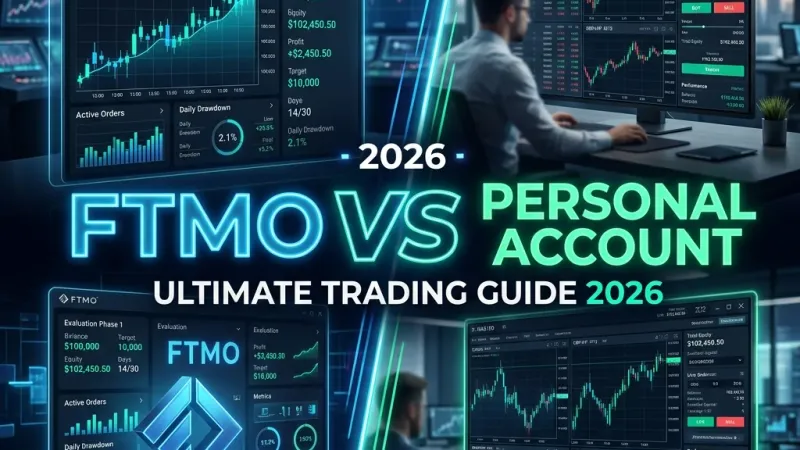
If you are a retail or quantitative trader in 2026, you face a critical career dilemma: should you trade an FTMO vs Personal Account?
For years, the proprietary trading industry sold retail traders a very specific dream: Why risk your own hard-earned capital when you can trade hundreds of thousands of dollars of our money?
However, following the massive regulatory shifts of 2024 and 2025, the reality of the prop firm space has fundamentally changed. FTMO, the industry pioneer, officially transitioned its legal framework from “funded accounts” to the FTMO data rewards model. While FTMO remains an incredibly reliable and polished platform with unmatched payout integrity, traders are beginning to realize that the restrictions of simulated prop environments come with heavy psychological and strategic costs.
In 2026, we are seeing a massive resurgence of profitable traders pulling their payouts from prop firms and returning to personal brokerage accounts.
Because we audit algorithms, test platforms, and actively trade both prop and personal capital at VerifiedPropFirm, we have the objective data. If you are analyzing the classic debate of a prop firm vs personal account 2026 is the year to make a highly strategic transition based on objective metrics. If you are torn between buying an FTMO challenge or depositing that same money into a personal live account, here is the ultimate breakdown of which path makes the most sense for your trading career.
The Capital Illusion: Understanding True Buying Power
The biggest selling point of FTMO is leverage. You pay roughly $500 for a $100,000 evaluation. If you pass, you get an 80% to 90% split on the data rewards you generate.
But you must understand the mathematical reality:
A $100,000 FTMO account is actually a $10,000 account.
Because your maximum overall drawdown is capped at 10% ($10,000), the remaining $90,000 is phantom capital. It exists purely to provide you with high leverage. If you lose $10,000, your account is terminated.
When comparing FTMO to a personal account, the accurate comparison is not a $100K FTMO account versus a $100K personal account. The realistic comparison is taking your personal $10,000 and depositing it into a live brokerage account.
To see this in action, look at our real-world setup below, where we actively trade both systems.
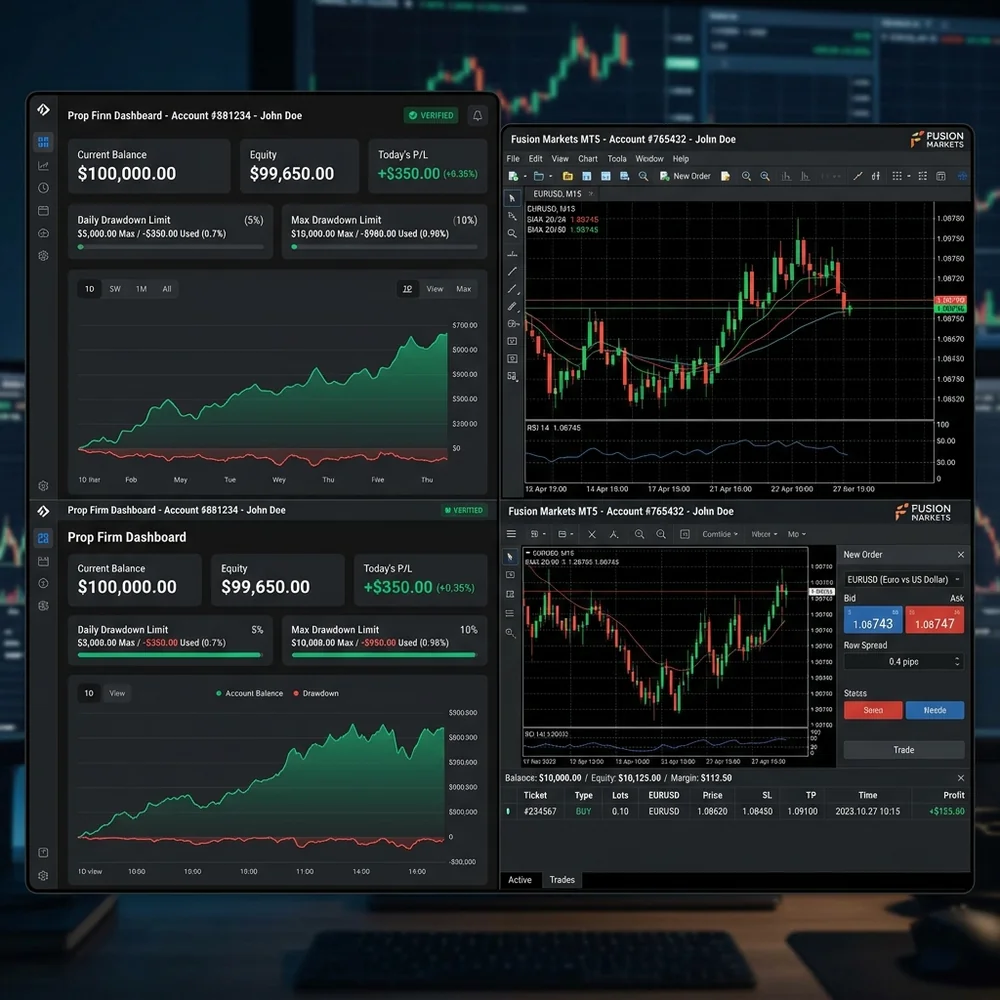 Proof of Active Trading: An active FTMO evaluation dashboard (left) showing strict daily loss parameters alongside a live, low-spread Fusion Markets MetaTrader 5 terminal (right) executing algorithmic and swing setups without arbitrary restrictions.
FTMO vs Personal Account: The 2026 Breakdown
To understand which model fits your style, we must look at the exact rules, restrictions, and financial returns under each path in 2026.
1. Rules, Restrictions, and Trading Freedom
FTMO’s Structured Environment
FTMO requires extreme discipline. You are bound by a strict 5% daily maximum drawdown and a 10% maximum overall loss. A single high-impact news event causing a volatility spike can breach your daily drawdown limit by a fraction of a percent. When that happens, your account is terminated instantly, and your accumulated profits vanish. You must purchase a new challenge and start from scratch.
The Absolute Freedom of a Personal Account
When trading your own capital, there are zero arbitrary rules:
- There is no daily drawdown limit.
- You can hold through catastrophic news events.
- You can hedge, use high-frequency trading (HFT) algorithms, or leave swing trades open for months.
- A 6% drawdown on a Tuesday does not lose you your account; it is simply a normal fluctuation you can recover from on Wednesday.
2. Profit Splits vs Keeping 100% of Gains
- FTMO: If you make 10% on your 100K FTMO account ($10,000), FTMO takes their 20% cut. You walk away with $8,000 (plus the refund of your initial challenge fee).
- Personal Account: If you make 10% on your personal $10,000 account, you make $1,000. You keep 100% of it.
On paper, the pure dollar amount generated from the leveraged FTMO account is much higher. However, you must factor in the psychological toll. The anxiety of maintaining a tight drawdown on a large simulated account frequently causes traders to make mistakes they would never make on a smaller, rule-free personal account.
Understanding the maximum drawdown mathematics shows why removing artificial rules gives your edge a massive statistical advantage.
The Broker Equation: Why Fusion Markets is the 2026 Standard
If you choose the personal account route, your success relies entirely on your choice of broker. After the MetaQuotes crackdown on unregulated offshore brokers, you need an entity that is highly regulated, offers deep liquidity, and provides raw spreads.
For traders transitioning away from prop firms in 2026, we strategically recommend reading our comprehensive Fusion Markets review 2026.
Why Fusion Markets Dominates for Personal Accounts:
- Lowest Cost to Trade: Fusion Markets routinely offers the lowest commission rates in the industry ($2.25 per standard lot compared to the industry average of $3.00 to $3.50). Over hundreds of trades, this drastically impacts your bottom line.
- No Minimum Deposit: You can start with exactly what you are comfortable risking.
- Regulation & Security: They are heavily regulated under ASIC regulation and the FSA, ensuring your funds are segregated and secure.
- Algo-Friendly Ecosystem: Unlike many prop firms that ban specific EA strategies or grid trading, Fusion Markets welcomes algorithmic developers. They provide ultra-fast execution speeds on MT4, MT5, and cTrader for deploying custom Expert Advisors.
If you are opening a live personal account, you can access our exclusive raw spread conditions with Fusion Markets through our Verified Broker Link.
The Verdict: Which Path Should You Take?
The decision comes down entirely to your current capitalization, trading psychology, and rule-tolerance.
Choose FTMO If:
You are undercapitalized and possess elite discipline. If you only have $500 to your name, putting it into a Fusion Markets personal account limits your earning potential. Using that $500 to buy an FTMO challenge gives you the leverage needed to generate a life-changing payout—provided your strategy can survive the strict FTMO drawdown rules vs live account parameters.
Choose a Personal Account (Fusion Markets) If:
You already have trading capital ($5,000 to $10,000+) and are tired of the psychological stress of prop firm evaluations. If you want absolute freedom to run your algorithms, trade through high-impact news, and keep 100% of your profits without fearing a sudden account termination, the personal account route with a trusted broker like Fusion Markets is the undisputed professional choice.
The Hybrid Strategy (The 2026 Pro Choice)
Many of our most successful traders at VerifiedPropFirm use a hybrid approach: They use FTMO evaluations strictly to generate capital injections, and then funnel those data-reward payouts directly into their Fusion Markets live account to build long-term, rule-free wealth.
Trade with Absolute Freedom
Open a $0 minimum deposit account at Fusion Markets and keep 100% of your trading profits.
Open Fusion Markets Account →*(Note: Using our verified partner link automatically applies ref code 80351, securing raw spreads and the industry-lowest $2.25/lot commission rate!)*

David Fox
Verified ExpertDavid Fox is a professional trader with over 12 years of experience. He specializes in algorithmic execution and risk management, having successfully passed multiple 6-figure evaluations at top-tier broker-backed firms. David personally audits every firm on this site by risking his own capital to verify broker execution and withdrawal reliability.