Static vs. Trailing Drawdown: Why Prop Firm Traders Prefer Static in 2026

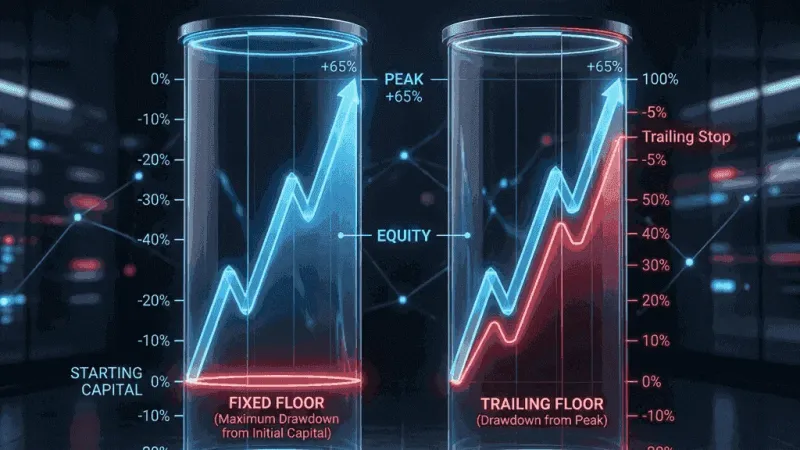
What is the difference between static and relative drawdown?
A static drawdown is calculated strictly from your initial account starting balance and never moves.
A relative drawdown (also known as a trailing drawdown) is calculated from your account’s highest recorded balance—the high-water mark—and moves up as you make profits.
Because relative drawdowns penalize traders for making profits and giving back unrealized gains, static drawdowns are widely considered better and significantly easier to pass.
If you have ever failed a proprietary trading firm challenge despite your account being in profit, you have likely fallen victim to the “trailing drawdown trap.”
As the prop firm industry matures in 2026, traders are becoming smarter about the rules they accept. Here is a deep dive into exactly how these two drawdown models work, and why choosing a firm with a static drawdown—or no arbitrary drawdown limits at all—is the ultimate secret to getting funded.
What is a Relative (Trailing) Drawdown?
A relative or trailing drawdown tracks your account’s highest peak—often including open, unrealized profits—and trails behind it by a fixed percentage.
It is designed to tightly protect the prop firm’s capital by preventing you from going on a massive winning streak and then giving all those gains back to the market.
The Relative Drawdown Trap (Example)
Let’s say you buy a $100,000 Challenge with a 5% Relative Drawdown.
- Day 1: Your starting balance is $100,000. Your maximum drawdown limit is $95,000.
- Day 2: You hit a great trade. Your account floats up to $105,000 (a $5,000 profit).
- The Trap: Because your new “high-water mark” is $105,000, your 5% drawdown level moves up to $100,000.
If the market reverses and your account drops back down to your starting balance of $100,000, you fail the challenge. You did not lose a single dollar of the firm’s initial capital, yet you breached your account simply by giving back a floating profit.
What is a Static Drawdown?
A static drawdown (sometimes called an absolute drawdown) is locked to your initial starting balance.
It does not care about your high-water marks, your unrealized profits, or your winning streaks. Your breach level remains exactly the same from Day 1 until you pass the challenge.
The Static Drawdown Advantage (Example)
Let’s use the exact same scenario on a $100,000 Challenge with a 5% Static Drawdown.
- Day 1: Your starting balance is $100,000. Your maximum drawdown limit is $95,000.
- Day 2: You make a $5,000 profit. Your balance is now $105,000.
- The Advantage: Your drawdown limit is still locked at $95,000.
You now have a massive $10,000 buffer (10%) before you fail the challenge. By securing profits, you actually bought yourself more breathing room to take future trades.
4 Reasons Why Static Drawdown is Better for Traders
1. Psychological Peace and Less Stress
Trading is 80% psychology. When you trade with a trailing drawdown, every floating profit that retraces feels like a punishment. Static drawdowns allow you to let your winning trades breathe without the anxiety of a moving breach level.
2. It Doesn’t Punish Winning Streaks
Prop firms that use relative drawdowns are essentially punishing you for having a good day. If you are up 8% for the month, a relative drawdown forces you to maintain an impossibly tight risk profile moving forward. A static drawdown rewards your winning streaks by expanding your safety net.
3. Ideal for Swing Traders
Swing trading naturally involves deep market pullbacks. If an asset spikes in your favor and then pulls back to gather liquidity, a relative drawdown will fail you. Static drawdowns allow you to use wider stop losses and weather normal market volatility.
4. Dramatically Higher Pass Rates
Statistically, the pass rates for prop firm challenges featuring static drawdowns are significantly higher than those with relative drawdowns. Top-tier prop firms in 2026 know that to attract serious, institutional-level traders, they must offer static risk parameters.
The Top 2 Firms to Escape the Trap in 2026
If you want a fair evaluation in 2026, you must trade with a broker-backed firm that offers transparent, static limits, or avoids arbitrary fail-states entirely.
1. FXIFY’s 2-Phase Pro (The Best Static Drawdown Challenge)
FXIFY recently launched the 2-Phase Pro program to meet the massive demand for fixed risk. It is currently widely considered the absolute best static drawdown offering in the entire prop firm industry:
- True Static Max Drawdown (8%): Your maximum loss level is fixed at 8% of your starting balance and never moves. If your account grows, your drawdown line stays exactly where it started.
- Simple Daily Loss Limit (4%): While the max drawdown is 8%, you must ensure you don’t lose more than 4% in a single day. Thankfully, this daily limit is also calculated based on your starting balance, not floating equity peaks.
- Aggressively Lower Targets: Requires just 4% in Phase 1 and 8% in Phase 2.
- No Consistency Rules (With a Safety Pause): There is no consistency rule, meaning you can trade at your own pace. To balance this, FXIFY uses a $4,000 daily profit cap. If you make more than $4,000 in one day, your account simply pauses (read-only mode) to protect your gains, and you can resume the next day.
- 10-Day Withdrawals: Once funded, you can request a withdrawal every 10 days (provided you meet a simple 3-day minimum trading requirement). Once you secure funded capital, apply our prop firm payout strategy to avoid the common drawdown traps that cause traders to lose their accounts.
2. Darwinex Zero (The “No Arbitrary Drawdown” Alternative)
If you hate drawdown traps entirely, Darwinex Zero offers a heavily regulated model built for long-term professionals:
- No “Breach” Levels that Fail You: They do not use hard drawdown rules to instantly terminate your account. Instead, they monitor your Value at Risk (VaR). If your strategy hits a drawdown, your allocation may simply decrease until you recover.
- No Profit Targets: You don’t have to force trades to hit an 8% target. You trade at your own pace, focusing purely on consistent risk-adjusted returns.
- Real Investor Capital: Once your strategy index proves consistent, you receive allocations from a pool of over €100+ million in real investor capital, earning a 15% performance fee.
- US-Friendly & FCA Regulated: Backed by an FCA-regulated broker, it remains 100% open and safe for US traders in 2026.
Ready to Trade with Fair Rules?
Predatory prop firms rely on tricky trailing drawdowns to intentionally fail retail traders and collect challenge fees. If you want to secure your trading future, you need to align yourself with firms that actually want you to win.
Ready to start?
Explore our comprehensive reviews for FXIFY and Darwinex Zero, and use our verified discount codes to get the best possible price on your signup fee!
Compound Your Payouts with Fusion Markets
Once you extract prop firm payouts, you need a high-trust, ASIC-regulated broker to compound your trading capital. Fusion Markets offers the lowest costs in the world with $2.25 commissions per side ($4.50 round turn) and raw 0.0 pip ECN spreads.

David Fox
Verified ExpertDavid Fox is a professional trader with over 12 years of experience. He specializes in algorithmic execution and risk management, having successfully passed multiple 6-figure evaluations at top-tier broker-backed firms. David personally audits every firm on this site by risking his own capital to verify broker execution and withdrawal reliability.